Back to Insights
Public Health 10 min read

SmartRefer: Voice-Powered Patient Referral System for Enhanced Efficiency in Bangladesh's Public Health Facilities

NoeticX Team
Dec 29, 2025
SmartRefer: Voice-Powered Patient Referral System for Enhanced Efficiency in Bangladesh's Public Health Facilities
View Full Image

Executive Summary

Bangladesh's public health referral system remains largely paper-based, leading to high self-referral rates, overcrowded tertiary hospitals, and limited visibility for planners across the system. SmartRefer is a voice-powered referral intelligence platform that enables clinicians to dictate referrals in Bangla or English, converting clinical speech into structured, anonymized, real-time data with minimal documentation effort. The platform enhances emergency preparedness through early hospital alerts and creates aggregated dashboards for national decision-making. An 18–24 month pilot will demonstrate improved referral compliance, reduced congestion, and provide policy-ready evidence for scaling up.

I. Problem Statement

The effectiveness of Bangladesh's tiered public health system—from Upazila Health Complexes (UHCs) to specialized tertiary hospitals—is significantly limited by weaknesses in referral management and data collection. The current referral process mainly depends on paper forms that are inconsistently filled out, poorly stored, and rarely compiled for systemic review. As a result, the referral pathway does not effectively regulate patient movement, leading to congestion at tertiary facilities, inefficient use of resources, and limited national-level visibility of service gaps.

1.1. Quantifying the Problem

The shortcomings of the current paper-based referral mechanism are reflected in widespread bypassing of the formal health system and significant data loss:

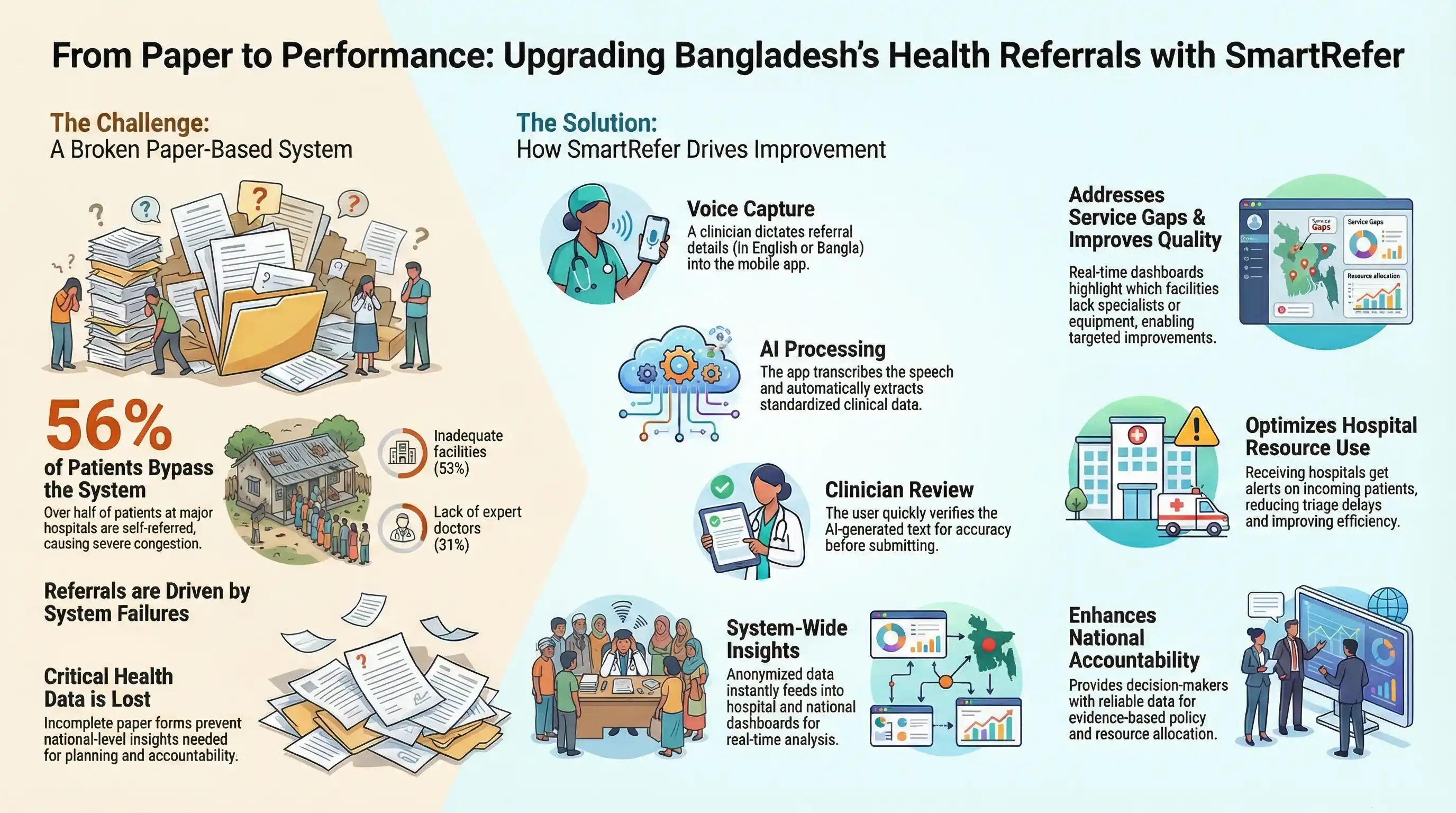
Widespread Bypass: An estimated 56% of patients arriving at government tertiary facilities, such as Dhaka Medical College Hospital, are self-referred, bypassing the formal referral system. This practice fills specialized centers with cases that could have been treated at lower levels.

Institutional Failure Drivers: Even when formal institutional referrals happen, they are often caused by system gaps. The main reasons given for referral include inadequate facilities to treat the patient (53%) and lack of expert physicians (31%) at the referring facility. These findings reflect long-standing human resource and infrastructure constraints within Bangladesh's public health system.

Data Loss and Quality Deficit: Paper referral documents are often incomplete, illegible, or lost during patient transfer, resulting in fragmented clinical information at receiving hospitals. The absence of standardized, digitized referral data prevents the Directorate General of Health Services (DGHS) and the Ministry of Health and Family Welfare (MoHFW) from obtaining real-time, aggregated insights required for national planning, epidemiological surveillance, and accountability.

This systemic documentation failure is further compounded by the low incentive for lower-level doctors and nurses to manually fill out extensive paper forms, which the proposed solution seeks to eliminate.

II. Solution: Voice-Powered Patient Referral System

SmartRefer is an innovative AI-powered intervention designed to turn referral documentation from a time-consuming manual task into a quick, voice-based process. By enabling clinicians to dictate referral details using a mobile app, SmartRefer boosts compliance while also creating structured, standardized, and anonymized referral data for system-wide analysis.

2.1. Core Value Proposition

SmartRefer's main behavioral innovation is converting unstructured spoken clinical narratives into structured, machine-readable data instantly. The system captures referral intent, clinical reasoning, and destination facility without tracking identifiable patient records. Aggregated outputs give central authorities useful insights into referral trends, disease burdens, and resource pressures across regions and specialties, aligning with global best practices for health system intelligence.

2.2. Key Objectives

The SmartRefer is designed to achieve the following strategic objectives:

Enhance data capture compliance: Ensure mandatory digital data collection for most institutional referrals by alleviating the manual documentation workload on frontline doctors and nurses.

Generate anonymized national insights: Enable DGHS and MoHFW decision-makers to access real-time, aggregated metrics—such as referral volume by specialty, primary reasons for transfer, and geographic trends—to support evidence-based resource allocation and policy formulation.

Improve operational efficiency at receiving hospitals by enabling tertiary care facilities to anticipate and prepare for high-priority referral volumes through real-time, aggregated dashboards. This reduces triage delays and enhances resource management.

Enforce clinical standardization: Use Natural Language Processing (NLP) to convert local clinical terms and provisional diagnoses into internationally recognized codes like SNOMED CT or ICD-11, making the aggregated data valuable for epidemiological surveillance.

III. Technical Architecture & Implementation Workflow

3.1. How SmartRefer Works

A seamless flow from the Upazila Health Complex to national decision-makers:

Voice Capture (Mobile Application): The clinician uses a minimalist, voice-first mobile interface to dictate referral information in English or Bangla.

AI Processing: Speech is transcribed into text, and predefined clinical and administrative data elements are automatically extracted and stored in a secure backend system.

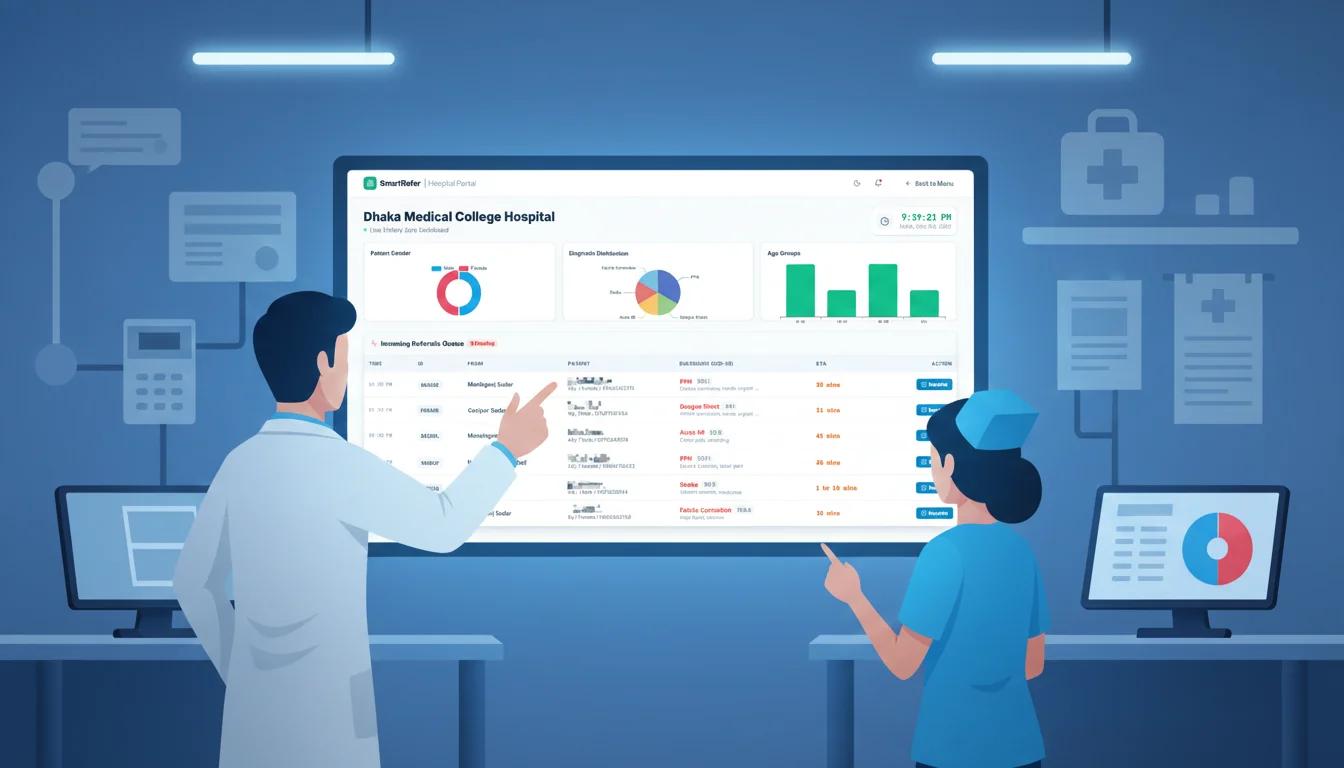
Receiving Hospital Alert: The destination facility's dashboard displays an anonymized alert summarizing the referral reason, specialty, and estimated arrival time.

National Dashboard: Aggregated, anonymized referral data feeds into a central DGHS dashboard, visualizing referral trends, service bottlenecks, and geographic disparities.

SmartRefer Target Facility Dashboard

Figure 1: SmartRefer Target Facility Dashboard

SmartRefer Central Dashboard

Figure 2: SmartRefer Central Dashboard

3.2. Implementation Workflow and Mitigation Strategies

The success of the system hinges on operational resilience, particularly concerning the infrastructure challenges faced by lower-tier facilities:

Mandatory User Review: The application displays the resulting transcription and extracted fields for immediate review by the doctor/nurse before submission. This human-in-the-loop step ensures clinical accuracy, mitigates risks associated with AI transcription errors, and builds user trust.

Capacity Building: Deployment is paired with structured, hands-on training programs focused on workflow integration and digital literacy. This is critical, as 75.6% of healthcare workers have cited inadequate training as a major constraint to effective system use in Bangladesh's public health sector.

IV. Quantifiable Achievements (24-Month Target)

The success of the SmartRefer will be measured by its ability to reverse the current trends of inefficiency and increase data visibility for the DGHS.

Metric CategoryKey Performance Indicator (KPI)Baseline (Estimate)Target (24 Months)Rationale/Impact
Data Collection EfficiencyDigital completion rate of institutional referrals~10%>75%Demonstrates system uptake and behavioral compliance
System Flow ImprovementSelf-referral Rate at government tertiary facilities56%<35%Indicates improved gatekeeping and system efficiency
Data Quality & InsightsReferrals citing "lack of expert physicians"31%<15%Reflects improved decision support and standardization
User AcceptancePublic tertiary-care patient satisfaction51%>65%Expected outcome of reduced overcrowding and faster triage

V. Conclusion

Moving from a fragmented, paper-based referral system to the low-effort, voice-powered SmartRefer platform is a practical and scalable step toward strengthening Bangladesh's public health system. By converting unstructured clinical voice inputs into standardized, aggregated data, SmartRefer provides MoHFW and DGHS with real-time insights needed to address service gaps, optimize resource use, and enhance accountability. Investing in SmartRefer builds a foundation for a data-driven, high-performing, and equitable national health system.